The Squeeze
Fire people. Inflate metrics. Consolidate. The AI industry is running the same playbook every engineer has already lived through.

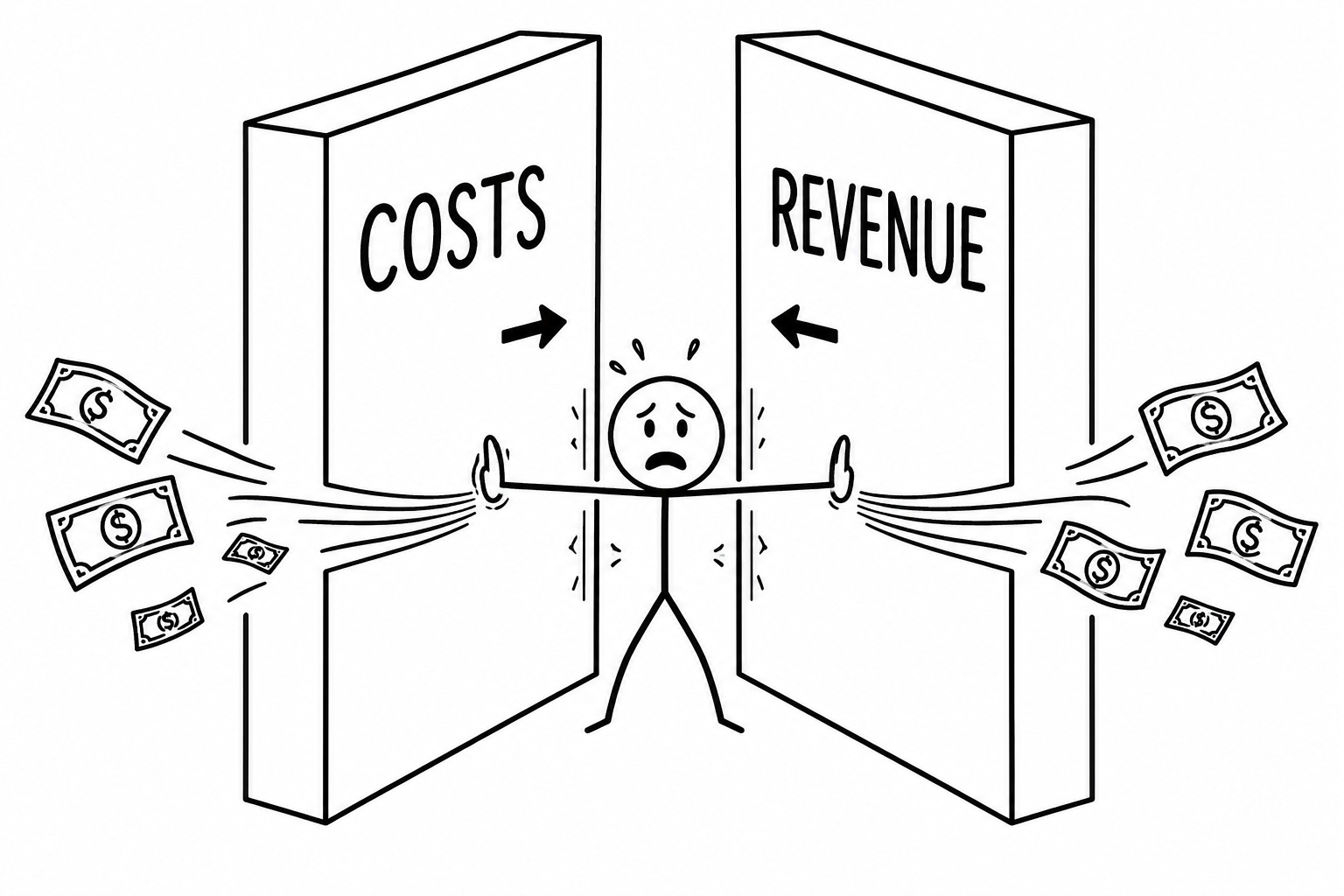
In one week in April 2026, Microsoft announced its first-ever voluntary buyout, Meta confirmed 8,000 more layoffs, and CNBC ran the headline “AI-driven labor crisis.” The same week, SpaceX revealed a $60 billion option to acquire Cursor. If you have spent any time inside a large company during an “efficiency” cycle, you recognize every one of these moves. The AI industry is not inventing a new strategy. It is running the oldest one in the corporate playbook — cut the bottom line, engineer the top line, merge to fill the gap — at a speed and scale that makes the pattern unmistakable.
The Squeeze
The headlines arrived in a cluster.
April 23: Microsoft offers voluntary buyouts to roughly 8,750 U.S. employees — 7% of its domestic workforce. The company has never done this in its 51-year history [1].
April 23: Meta confirms it will cut 8,000 jobs on May 20, with 6,000 additional open roles eliminated. Capital expenditure is jumping to $115–135 billion, up from $72 billion the year before [2].
April 21: SpaceX reveals it holds a $60 billion option to acquire Cursor, the AI coding editor valued at $2.5 billion just fifteen months earlier. Microsoft reportedly bid too [3] [4].
March 31: Oracle cuts 30,000 employees in a single day — the largest mass layoff in tech history — to free $8 billion in cash flow toward $50 billion in AI data centers [5].
January: Amazon eliminates 16,000 corporate roles.
Combined AI infrastructure spending by five companies — Alphabet, Microsoft, Meta, Amazon, and Oracle — will reach roughly $700 billion in 2026. Over 96,000 tech workers have been laid off so far this year, with analysts projecting 265,000 by December [6].
The headlines say “AI-driven labor crisis” and “record AI investment.” Both are true at the same time, at the same companies, in the same quarter. That is the tell.
Fire to Fund
Every company at the AI infrastructure table is funding its bet with the same currency: the salaries of the people it no longer employs.
Oracle cut 30,000 to free $8 billion toward $50 billion in data centers — mostly for one customer, OpenAI, which is not profitable. I wrote about Oracle’s version of this bet separately: $125 billion in debt, negative $25 billion in free cash flow, 54% of its backlog tied to a single account. Oracle is the only company at the table that borrows to play. The others self-fund. But the mechanism is the same.
Microsoft is spending $80 billion on AI data centers while offering buyouts for the first time in its history. Meta is cutting 10% of its workforce while nearly doubling CAPEX. Amazon eliminated 16,000 roles in January.
These companies are not cutting because AI replaced the work. They are cutting to fund infrastructure for AI that has not replaced the work yet. The layoff precedes the capability. The savings fund the bet, not the result.
If you have been through an “efficiency” initiative inside a large company, you recognize the sequence. The headcount target arrives first. The rationale arrives second. The press release calls it investment.
The timing is worth noticing. Meta and Microsoft both announced their cuts on April 23. Both companies report earnings on April 29. Six days. The layoffs are not bad news being buried. They are the opening act for the earnings call — the “efficiency” story that analysts want to hear, delivered with enough lead time for the stock to react before the numbers drop. Oracle did it differently: a quiet mass email at 6am, no public announcement, three weeks after its March 10 earnings. One company stages the layoff as a narrative. The other buries it. Both are gaming the stock price.
Inflate to Grow
Three things happened to AI pricing at the same time.
New models cost more per token. Anthropic’s Opus 4.7 charges $15 per million input tokens and $75 per million output tokens. Extended thinking — where the model reasons before responding — costs $25 per million tokens, with default budgets in the tens of thousands per request. A task that cost a penny eighteen months ago now costs fifty cents when the model thinks for 20,000 tokens before answering.
New models consume more tokens per task. Opus 4.7 ships with a new tokenizer that produces up to 35% more tokens for the same input text [7]. A thousand words that generated X tokens last year now generates up to 1.35X tokens. Coding agents that loop, retry, and spawn sub-agents multiply consumption further — by factors of three to fifty. Claude Code had a bug earlier this year that drained rate limits 3–50x faster than expected; users on the highest-tier plan exhausted their monthly allocation within 70 minutes [8].
And billing shifted from flat-rate to per-token. GitHub Copilot paused new signups on April 20 because agentic workflows broke the economics of flat pricing. Internal documents show weekly costs nearly doubled since January. Microsoft is moving all Copilot subscribers to token-based billing in June [9]. Anthropic moved to per-token billing in April.
Higher price per token. More tokens per task. Every token metered. Three levers, all pushing the same direction. That is not a market finding its price. That is a revenue stream being engineered.
The squeeze does not stop at the provider. It cascades. The companies that adopted AI now face rising costs on tools their teams depend on. They have two options: cut people to cover the token bill, or cap token usage to hold the budget. Either way the customer runs the same playbook the provider is running — shrink the bottom line to protect the top line. The squeeze reproduces itself down the chain.
Capping usage sounds like the rational move until you try it. AI-assisted codebases are not like other projects. The agent holds context that no one else has. The patterns it introduced are patterns it understands better than the team does. Pulling back mid-project does not return you to where you were before you started. It leaves you with a half-built system that was designed in collaboration with a tool you can no longer afford to use. It is like gutting your kitchen and running out of money for the contractor. You do not get your old kitchen back. You get plywood countertops and no stove.
I have done this — the AI version, not the kitchen. I downgraded my Claude subscription when I decided that $250 a month on a hobby is not worth it, and now I am coasting on free credits from a promotional window while shopping for cheaper models on OpenRouter. The project I was building did not pause with me. It sits half-finished, waiting for context that lives in a tool I chose to stop paying for.
There is a broader question here that goes beyond AI industry economics. When every company’s tooling costs rise simultaneously through mechanisms that do not appear on any rate card — new tokenizers, thinking overhead, billing model shifts — and those costs get absorbed into the price of everything those companies build, that is inflation. Not the AI industry’s version of inflation. Actual inflation. The kind that Tracy Alloway and Joe Weisenthal would cover on Odd Lots. I do not have the macroeconomic training to trace the full chain. But I can see the first links: $700 billion in infrastructure spending, rising per-task costs passed through to every company that builds with these tools, labor budgets shrinking to cover the difference. That money comes from somewhere and goes somewhere. It does not disappear.
The constraint underneath all of it is that this revenue draws from a finite pool. I have written about where the money comes from — it comes from labor budgets, R&D budgets, the same corporate line items that used to pay people. Those budgets are not growing at 10x per year. They are not growing at 2x. The milkshake is not bottomless.
Consolidate to Survive
SpaceX merged with xAI in February at a combined valuation of $1.25 trillion. Then it struck a deal: a $60 billion option to acquire Cursor, or pay $10 billion for their collaborative work. Cursor was valued at $2.5 billion in late 2024, $9.9 billion by early 2025, and $29.3 billion after its Series D in November [3]. Microsoft reportedly explored acquiring Cursor before the SpaceX deal materialized [4].
The logic is not complicated. SpaceX operates GPU infrastructure at scale for Starlink and xAI. Cursor has millions of developers generating token revenue. Acquire Cursor, and SpaceX gets a software revenue stream that runs on compute it already operates. Cursor gets captive infrastructure at cost instead of paying another company’s API margins. Revenue maps to operating cost. Both sides close their gap.
This is not a technology acquisition. It is vertical integration. An oil company buying a gas station chain.
The pattern is everywhere. In Q1 2026 alone, 266 AI-related M&A deals closed — a 90% year-over-year increase [10]. Global deal value hit $4.9 trillion in 2025, surpassing the 2021 record. BlackRock’s consortium acquired Aligned Data Centers for $40 billion. Salesforce bought Informatica for $8 billion. IBM bought Confluent for $11 billion.
When everyone consolidates at once, it means standalone economics do not work. You need someone else’s balance sheet, or someone else’s customers, to make the numbers add up.
The Pattern
All three moves serve the same function: close the gap between what AI costs to build and what it generates in revenue.
Firing people converts salary obligations into present-day capital for infrastructure. Engineering token pricing grows the top line through three compounding levers. Consolidating merges balance sheets so that costs on one side become revenue on the other.
This is not an AI strategy. It is the strategy. The one every large company runs when organic growth cannot hit the profit target. Cut the bottom line. Engineer the top line. Merge to fill the gap.
The problem is that even with all three levers, revenue is not keeping pace with costs. Five companies are spending $700 billion on infrastructure this year. Total AI industry revenue — Anthropic, OpenAI, Microsoft’s AI line, Google Cloud’s AI-driven growth, everyone else combined — is approaching $100 billion. The gap is seven to one.
And the adoption underneath that revenue is narrower than it looks. Microsoft Copilot lost 39% of its paid market share in six months. Its accuracy Net Promoter Score crashed to negative 24 — more users distrust it than recommend it [11]. GitHub paused new signups because the customers it does have cost more to serve than they pay. Most large corporations have not adopted AI coding tools at scale. The ones that announce it loudest — Block, for example — are selling the narrative to Wall Street as much as they are using the technology. When Block cut 4,000 people and its stock surged 24%, the market was not rewarding AI adoption. It was rewarding headcount reduction. The AI was the story. The layoff was the product.
So the revenue pool is finite, the adoption is shallow, and the infrastructure bill is $700 billion. The three plays — fire, inflate, consolidate — are not signs of an industry building toward profitability. They are signs of an industry trying to engineer a profit target it cannot reach organically.
If you have ever sat in an all-hands where the CEO said “we are investing in the future” the same quarter your team lost three headcount, you know what $700 billion in AI CAPEX funded by 96,000 layoffs looks like from the inside. It looks like your desk.
The question is whether the underlying business — AI models sold as API calls and subscriptions — will eventually generate enough cash to make the borrowing unnecessary. If it does, this was a transition. The layoffs were painful but temporary. The infrastructure will earn its keep.
If it does not, this was a bubble. And the people who funded it with their jobs will not get them back.
REFERENCES
[1] CNBC (2026). “Microsoft plans first voluntary retirement program for U.S. employees.” CNBC. April 23.
[2] CNN (2026). “Meta to cut 10% of staff as AI reshapes the company.” CNN Business. April 23.
[3] CNBC (2026). “SpaceX says it can buy Cursor later this year for $60 billion, or pay $10 billion for ‘our work together.’” CNBC. April 21.
[4] CNBC (2026). “Microsoft looked at buying Cursor before SpaceX deal, sources say.” CNBC. April 22.
[5] CNBC (2026). “Oracle cutting thousands of workers as AI spending ramps up.” CNBC. March 31.
[6] Yahoo Tech (2026). “Tech layoffs 2026: over 96,000 employees have been laid off this year.” Yahoo Tech. April.
[7] Finout (2026). “Claude Opus 4.7 Pricing: The Real Cost Story Behind the Unchanged Price Tag.” Finout Blog.
[8] Morphllm (2026). “The Real Cost of AI Coding in 2026.” Morphllm Blog.
[9] Where’s Your Ed At (2026). “Exclusive: Microsoft Moving All GitHub Copilot Subscribers to Token-Based Billing in June.” Where’s Your Ed At.
[10] PwC (2026). “Global M&A Trends 2026.” PwC.
[11] Stackmatix (2026). “Microsoft Copilot Adoption Statistics & Trends.” Stackmatix.