Oracle's Nortel Moment
Cut 30,000 people. Borrow $50 billion. Bet it all on a customer that isn't profitable. I have seen this before.

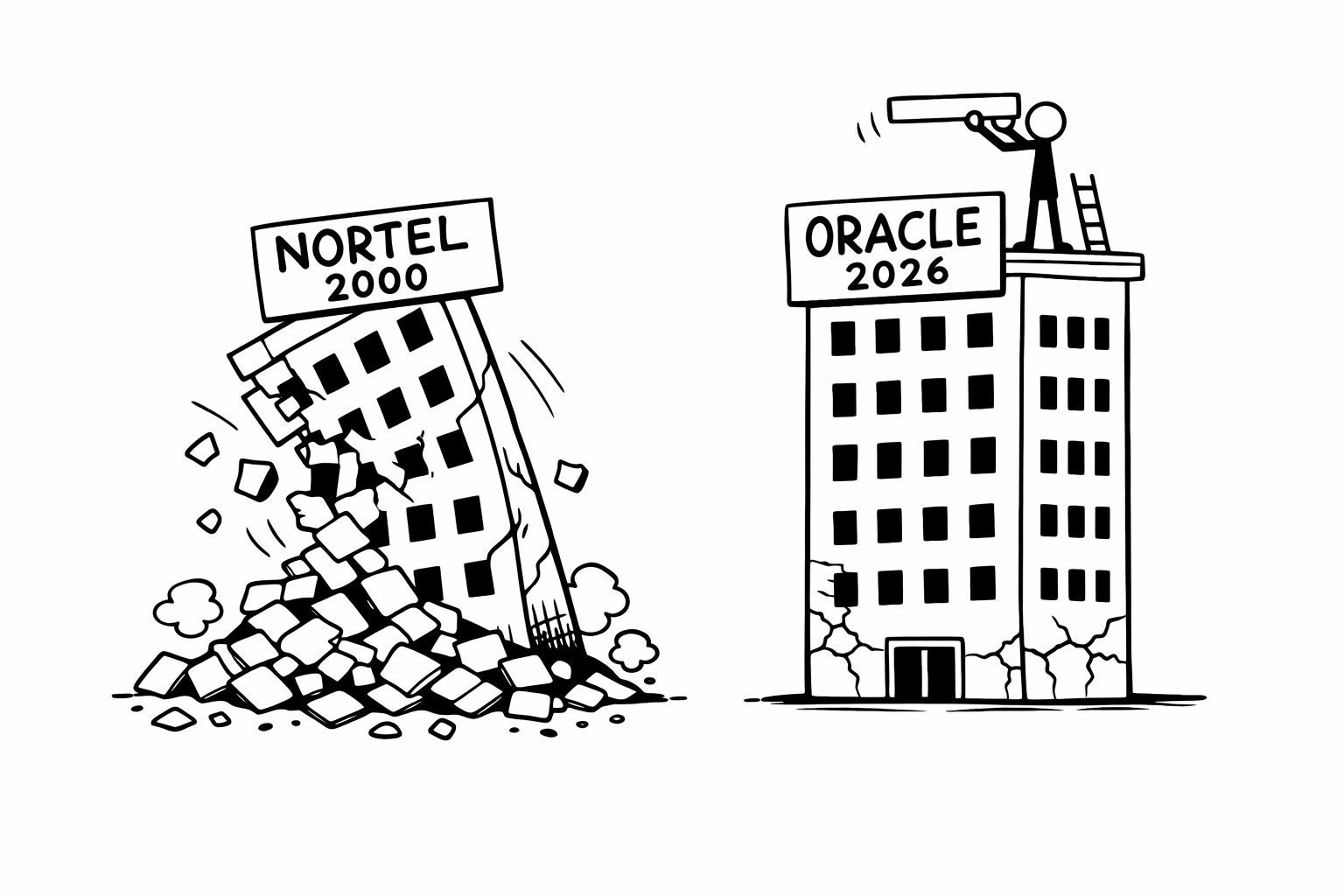
Oracle cut 30,000 employees to free up $8 billion in cash flow, then borrowed $50 billion to build AI data centers — mostly for one customer, OpenAI, which is not profitable. The company carries $125 billion in debt, negative $25 billion in free cash flow, and a debt-to-equity ratio of 500%. Every other company making the same AI infrastructure bet is self-funding it. Oracle is the only one borrowing to play. I worked at Nortel. I held stock options at $118 that went to zero. The financial structure is not identical, but it rhymes.
I Have Seen This Before
I was a software developer at Nortel Networks from 2000 to 2001. I held stock options at $118 a share. Nortel had $30 billion in revenue, 95,000 employees, and a market capitalization of C$398 billion. It was the largest company in Canada. The buildings in Ottawa were full. The parking lots were full. The confidence was absolute.
I got laid off. Twice. The stock went from $118 to zero — not a figure of speech, actual bankruptcy. I couldn’t find work. Nobody could. Ottawa’s tech sector didn’t just contract — it evaporated. I ended up in graduate school at the University of Toronto, not because I had always planned to get a PhD, but because there were no jobs. I’ve written about this before — how potential becomes invisible when markets tighten, and proof is the only thing that survives. That lesson cost me two layoffs and six years of school.
When I read Oracle’s financials, I feel something I haven’t felt since 2001. Not certainty that it will collapse — I don’t know that. Recognition. The shape of the bet is familiar. The confidence is familiar. The gap between the story and the numbers is familiar.
The Numbers
Oracle reported its best organic growth quarter in fifteen years. Revenue hit $17.2 billion for Q3 FY2026, up 22% year over year. Cloud revenue grew 44%. The business is growing [1].
Here is the other side of the ledger:
Total debt: $125 billion, with a debt-to-equity ratio of 500%
Free cash flow: negative $24.7 billion trailing twelve months
Capital expenditure: $50 billion for FY2026, up from $21 billion the year before
Remaining performance obligations (backlog): $553 billion
Of that backlog, approximately $300 billion — 54% — is one customer: OpenAI [2]
Stock down 24% year to date, down 50% from its September 2025 high of $327 [3]
Barclays downgraded Oracle’s debt to one notch above junk and stress-tested the balance sheet. Their conclusion: Oracle could run out of cash by November 2026 [4]
Now compare Oracle to the other companies making the same AI infrastructure bet:
Company2026 CapexLayoffs (2026)Self-funded?Amazon~$200B~16,600YesAlphabet$175-185BBroad cutsYesMicrosoft$120B+~16,600YesMeta$115-135B15-16KYesOracle$50B30,000No
Oracle is spending the least and cutting the most. It is also the only company at the table that cannot self-fund its bet. Microsoft, Amazon, Meta, and Google generate the cash to build data centers from their operating businesses. Oracle borrows [5].
The Pattern
Nortel’s death spiral had three stages. First, it financed customers who couldn’t pay — lending over $7 billion to startup telecom carriers to buy Nortel equipment, much of it unsecured and interest-free. Second, it used its inflated stock price as collateral for further deals. Third, when the customers defaulted and the stock collapsed, the debt remained. Nortel took a $12.3 billion goodwill write-down in 2001. Shareholder equity went negative. The debt-to-equity ratio became mathematically undefined — not because the ratio was high, but because there was no equity left [6].
Oracle is not lending money to its customers. That is the difference. But the dependency chain has the same shape. Oracle borrows to build data centers. The data centers are built primarily for OpenAI. OpenAI has approximately $25 billion in annual revenue and is burning cash. If OpenAI’s revenue growth does not materialize at the scale the contract assumes, Oracle is holding $125 billion in debt for data centers that are underutilized [2].
Tomasz Tunguz published an analysis in early 2026 identifying over $800 billion in circular financing arrangements across the AI ecosystem — chip makers invest in AI startups, startups spend that money buying chips, hosted at cloud providers who borrow to build capacity [7]. The same analysis noted that in the dot-com era, Lucent was owed over $8 billion, Nortel over $3 billion, and Cisco over $2 billion in vendor-financed customer loans. Between 2000 and 2003, 47 competitive local exchange carriers went bankrupt, and 33-80% of vendor loan portfolios went uncollected.
Oracle’s version is indirect. The financing runs through its own balance sheet rather than through customer loans. But the structural question is the same: does the customer at the end of the chain generate enough revenue to justify the debt that built the infrastructure they use?
The Abilene, Texas data center expansion — the flagship Stargate Project facility — was cancelled after financing negotiations broke down [8]. That is the first crack. One cancelled expansion does not mean collapse. But at Nortel, the first cancelled contracts didn’t mean collapse either. They meant the assumptions were wrong.
What It Looks Like from Inside
On March 31, 2026, up to 30,000 Oracle employees received an email. No meeting. No warning [1]. TD Cowen analysts estimated the layoffs would free $8 to $10 billion in cash flow — enough to service the debt for now.
The people who remain inherit the obligation. They have to build and operate the AI infrastructure with fewer colleagues, in a company leveraged beyond anything the industry has seen. Oracle is pricing its cloud 50-80% below AWS. It is offering credits — $0.25 per dollar spent on OCI — to prevent existing customers from leaving. It is asking new customers to pre-fund data center builds because it does not have the cash to build speculatively [9]. These are not the behaviors of a company operating from strength. These are the behaviors of a company managing a cash crisis while maintaining the appearance of growth.
I’ve written about what happens inside companies after layoffs. Block cut 4,000 people and the stock surged 24% — that was a margin play, a company with healthy fundamentals trimming costs. Oracle cut 30,000 people while carrying $125 billion in debt and negative free cash flow. That is not a margin play. That is a company choosing which bills to pay.
What Might Save Them
Oracle has something Nortel did not: a profitable legacy business. Oracle’s database licensing, enterprise software, and on-premises support contracts generate real cash flow. Nortel’s core telecom equipment business was already declining when the financing unraveled. If Oracle’s legacy business holds, and if the $553 billion backlog converts to real revenue by 2029-2030, the Guggenheim “free cash flow waterfall” thesis plays out — capex normalizes, contracted revenue flows in, the debt becomes manageable [10].
That is the bull case. It requires Oracle’s largest customer to become profitable at scale, the AI infrastructure market to grow as projected, no competitor to undercut Oracle’s pricing, and the legacy business to remain stable while the company’s attention is elsewhere. Everything has to go right for three years.
At Nortel, the bull case was simpler: internet traffic would keep growing, telecom carriers would keep buying equipment, the contracts would convert to revenue. Internet traffic did keep growing. The carriers still went bankrupt. The assumption was right. The customers were wrong.
I don’t know if Oracle is Nortel. The structure is different enough that it might not be. But I know what it feels like to hold stock options in a company that everyone says is too big to fail, in a market that everyone says will keep growing, while the debt piles up and the layoffs get larger. I have felt that confidence before. It felt like this.
REFERENCES
[1] CNBC (2026). “Oracle cutting thousands in latest layoff round as company continues to ramp AI spending.” https://www.cnbc.com/2026/03/31/oracle-layoffs-ai-spending.html
[2] 24/7 Wall St (2026). “Oracle: The $500 Billion Backlog vs. the $125 Billion Debt.” https://247wallst.com/investing/2026/04/03/oracle-the-500-billion-backlog-vs-the-125-billion-debt/
[3] Motley Fool (2026). “Oracle Shares Are Down 24% So Far in 2026 Amid AI Bubble Fears.” https://www.fool.com/investing/2026/04/06/oracle-shares-are-down-24-so-far-in-2026-amid-ai/
[4] Fortune (2026). “Oracle under pressure from more than $100 billion in debt and massive layoffs.” https://fortune.com/2026/03/09/oracle-earnings-layoffs-debt-cloud/
[5] Oracle (2026). “Oracle announces Equity and Debt Financing Plan for Calendar Year 2026.” https://investor.oracle.com/investor-news/news-details/2026/Oracle-announces-Equity-and-Debt-Financing-Plan-for-Calendar-Year-2026/default.aspx
[6] Light Reading. “The Decline & Fall of Nortel Networks.” https://www.lightreading.com/optical-networking/the-decline-fall-of-nortel-networks
[7] Tunguz, T. (2026). “Circular Financing: Does Nvidia’s $110B Bet Echo the Telecom Bubble?” https://tomtunguz.com/nvidia_nortel_vendor_financing_comparison/
[8] Tom’s Hardware (2026). “OpenAI’s Massive Stargate Data Center Canceled.” https://www.tomshardware.com/tech-industry/artificial-intelligence/openais-massive-stargate-data-center-canceled-as-firm-cant-reach-terms-with-oracle-operator-struggles-with-reliability-issues-meta-said-to-be-interested-in-snatching-excess-capacity
[9] Oracle (2026). Cloud Support Rewards. https://www.oracle.com/cloud/rewards/
[10] 24/7 Wall St (2026). “Guggenheim Analyst Predicts Oracle Free Cash Flow Waterfall in Fiscal 29-30.” https://247wallst.com/investing/2026/03/11/guggenheim-analyst-predicts-oracle-free-cash-flow-waterfall-in-fiscal-29-30/